
The Intention
I restarted a painting this week in the hopes that I could completely stray from the original intent. Spoiler: that didn’t really happen, but what did happen was somehow more exiting for me.
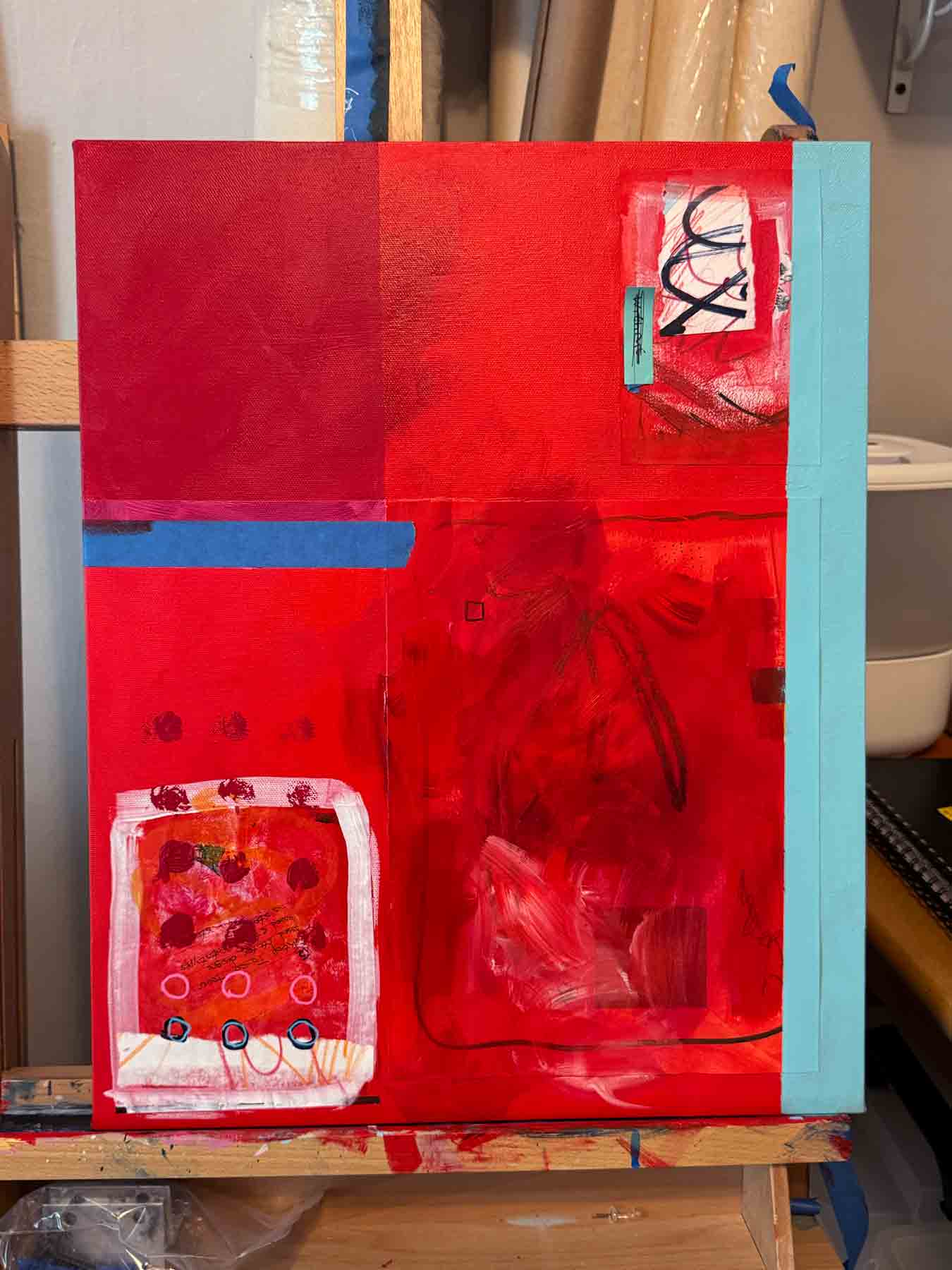
It started, like a lot of my work does, with color. A red field. Bold, hot, a little aggressive. I wasn’t thinking about composition or meaning yet, just the feeling of putting that color down. That permission to be unapologetically loud.
Then came the layers. It started off initially as an idea to layer moments of piece everyday, things that are obviously connected but will find meaning in a shared context. This is something I’m definitely still thinking about and hoping to explore further. However, it just wasn’t working for me in this piece. I added collages works, I added marks, more colors, more textures. The more I added, the more unsettled and chaotic I felt.

The Realization
Every time I added something, the painting got more complicated. More fractured. More honest, in a way I didn’t totally expect.
Somewhere in the middle of making it, I realized what it was actually about.
I’m someone who gets pulled in a lot of directions at once, emotionally, creatively, in life. There are things I want that contradict each other. Feelings that don’t resolve neatly. And for a long time, I’ve thought about that as a problem to solve, something to organize into something cleaner and more coherent.
But looking at this painting, with its competing focal points and intentional interruption and its spray mark fighting for space with the other marks and textures, I started to think: what if the chaos isn’t the problem? What if the chaos is the honest part?
The challenge then became something more interesting than “how do I fix this.” It became: how do I make something that feels chaotic and unresolved but also feels intentional? How do I author the mess rather than just produce it?


Some things I’ve been sitting with:
The pink arc is the spine of the painting. Everything else is in conversation with it, even when the conversation is an argument. I’m trying to let it lead.
The scribbles matters more than I initially gave it credit for. There’s something true in those small private marks. I’m thinking about whether that language needs to echo somewhere else on the canvas.
One version of finishing this painting was making it quieter. Another version was making it louder in all the right places. I didn’t know yet which direction it should go, but I think that uncertainty is part of the process, not a failure of it.
Sometimes a painting teaches you something about yourself while you’re making it. This one is teaching me that I don’t always have to resolve the tension. I just have to own it.

without 22.36.02.21.26
Mixed media & collage on canvas, 16×20
2026
The Final Piece
In the end, I didn’t resolve the tension. I documented it. The squares came last, and they came with intention. Not as decoration, not to fill space, but as a kind of formal acknowledgment, a way of saying: this happened here, and this, and this. Each one is a container. A moment held still long enough to be seen. In a painting that had been all movement and competing energies, the squares became the act of bearing witness to the whole thing.
There’s something I’ve been thinking about around acceptance, not as resignation, but as clarity. When I added the swatches, I wasn’t trying to calm the painting down. I was trying to honor what was already there. The fragments, the contradictions, the layered history of the making. The squares say: I see all of this. I’m not going to clean it up. I’m going to give it a frame. What I ended up with is a painting that holds a lot of things at once: loudness and stillness, chaos and structure, the messy private marks and the deliberate architectural gestures. And that feels more truthful to me than anything I could have planned from the start.
I came into this painting trying to erase my original intent. What I found instead was something I didn’t know I needed to say: that acceptance isn’t the same as resolution. Sometimes it’s just the willingness to look at all the pieces and say sure, this is what it is. And that’s enough.